
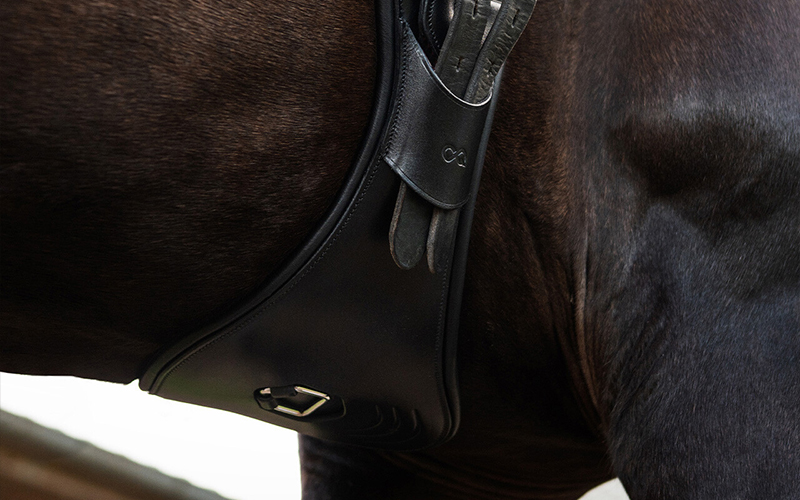
Short, long or stud
Girths
The girth holds the saddle in place and sits directly in the sensitive girth area behind the elbow. At Lepona you will find short girths for dressage saddles, long girths for jumping and eventing saddles, stud girths, anatomic shapes and girths with sheepskin or faux fur, from brands including Kavalkade, Busse, Mattes and Waldhausen. Unsure about length or shape? We are happy to advise you by phone, WhatsApp or video.


Which girth suits your saddle and your horse?
A suitable girth lies smoothly in the girth area, doesn't press into the elbow and can be tightened evenly. Which girth fits depends mainly on three things: the saddle (short or long girth straps), your horse's conformation and the use.
Short girths:
- for dressage saddles, with long saddle flaps and girth straps
- Girth buckles end at the lower edge of the saddle flap
- Girth buckles should be well above the range of movement of the elbow
Long girths:
- for the jumping saddle
- Girth buckles are located under the saddle flap
- usually fitted with D-rings for attaching a martingale
Stud girths:
- for show jumpers with a lot of action in the foreleg
- wide plate protects the chest & belly area from studs in the horseshoe
Different girth shapes for an optimum fit
Short girth, long girth or stud girth?
- Short girth (dressage girth): for saddles with long girth straps, typically dressage saddles. The buckles sit under the saddle flap but above the elbow, so that nothing bulks up under the rider's leg.
- Long girth: for saddles with short girth straps, such as jumping, eventing and many general-purpose saddles. The buckles sit under the saddle flap. Many long girths have D-rings for attaching a martingale.
- Stud girth: a long girth with a wide plate on the underside. It protects the belly when the horse tucks its forelegs up sharply when jumping and wears studs in its shoes.
Straight, anatomic or moon girth?
A straight girth is the same width throughout and suits horses with a clear girth groove. Anatomic girths are cut back in the elbow area and wider in the middle, so that pressure is distributed and the elbow has room. With asymmetric girths only the front edge is cut away more. Moon girths are strongly curved and suit horses with a round ribcage, narrow chest or a girth groove close to the elbow, where the girth tends to slide forward.
Material: leather, synthetic, neoprene or sheepskin
Leather girths are durable but need regular care with leather care. Girths made of synthetic material, neoprene or gel can usually simply be washed off. Sheepskin and faux fur lie softly and are often used for sensitive skin; many models have a removable fur cover that can be washed separately. Elastic inserts on one or both sides give a little when the horse breathes. Make sure the elastic sits evenly on both sides or deliberately on one side only, as recommended by your saddler.
Measuring the right girth length
The length of a girth is measured from buckle end to buckle end. The easiest way is to measure on the saddled horse: place the tape measure at the bottom hole of the girth strap on one side, run it through the girth area under the belly to the other side and read it off at the bottom hole. Deduct a little from this value so that you can later fasten the girth in the middle holes. This leaves room to tighten it. If you already have a well-fitting girth, use its length as a starting point. With short girths the buckles should sit a hand's width above the elbow, with long girths they should disappear under the saddle flap without overlapping the buckle guards.
Putting on and caring for a girth
Girth your horse up gradually: loosely at first, then tighten after leading or before mounting. Pull evenly on both sides so that the saddle doesn't slip. After riding, wipe off sweat and dirt, care for leather parts and wash fur covers regularly. Check seams, elastic and buckles before every ride.
Girths from well-known brands
We stock girths from Kavalkade, Busse, Mattes, Waldhausen, Kentucky Horsewear, Passier and other manufacturers through to the girths from LeMieux. You will find matching accessories such as saddle pads, stirrups and pads in saddle accessories.
Straight girth:
- cut to the same width throughout
- for horses with an even build and pronounced girth position
Anatomical girth:
- cut out at the front and back in the elbow area of the horse
- slightly wider cut in the chest area
- ensures better pressure distribution
- suitable for horses with a pronounced girth position and enough distance to the elbow
- can be used in both directions
Asymmetrical girth:
- more cut back on the front side in the elbow area
- rear side is more straight
- The contact surface in the chest area is also slightly wider and thus ensures good pressure distribution
- for horses with a girth position that is closer to the elbow or less pronounced
Moon girth:
- for round-ribbed horses, horses with a narrow chest or short back
- absorbs the curvature of the ribs thanks to its special cut and prevents pressure points and chafing
- cut back strongly in the elbow area
- cut shorter at the front than at the back
Different materials for different needs
Leather saddle girths are suitable for almost any horse. This is because leather is soft, supple and hard-wearing at the same time. With leather saddle girths, you must ensure that the leather is cared for regularly.
Neoprene is suitable for sensitive horses with sensitive skin, as the material is soft and flexible.
Synthetic leather girths are also very easy to care for and can be easily washed under water. However, make sure you take good care of the artificial leather so that the surface does not become brittle.
Saddle girths with gel or memory foam are usually also made of neoprene or nylon. The gel or memory foam filling is designed to relieve pressure and prevent chafing.
Saddle girths with lambskin are particularly suitable for changing coats and for sensitive horses that are prone to chafing. The lambskin has a climate-regulating and pressure-relieving effect. However, bear in mind that the thickness of the fur means that it cannot always be girted tightly. Your saddle should therefore be in a very good position and not slip.
Girths with or without elastic?
Most standard saddle girths have an elasticated insert to connect the girth buckle to the saddle girth. This allows the girth to give to a certain extent. This can be helpful for horses with saddle or girth constraints, as long as the girth is not pulled too tight.
Unfortunately, elasticated inserts tempt you to tighten the girth too much. If you choose a saddle girth with elastic, always girth with feeling and caution so that your horse does not develop a defensive attitude towards the girth.
Short girths go with saddles with long girth straps, usually dressage saddles. Long girths go with saddles with short girth straps, such as jumping and eventing saddles. So what matters is your saddle, not the discipline alone.
On the saddled horse, measure from the bottom hole of the girth strap on one side, under the belly, to the bottom hole on the other side. Deduct a little so that you can fasten the girth in the middle holes. A well-fitting old girth is the best comparison.
An anatomic girth is cut back in the elbow area and gives the elbow more room. It is a good choice if the girth sits close to your horse's elbow or a straight girth slides forward. You can best see whether it fits when the horse is moving.
A stud girth has a wide plate on the underside. It protects the horse's belly when it tucks its forelegs up sharply when jumping and wears studs. For training without studs, a normal long girth is usually enough.
Sheepskin and faux fur lie softly and are often used for horses with sensitive skin. It is important that the cover stays clean and dry. Many models have a removable cover that you can wash separately.
Elastic inserts give a little and make tightening the girth more precise. Some riders and saddlers prefer elastic on one side only, so that the saddle isn't pulled to one side. If in doubt, ask your saddler what suits your saddle.