
Basics & effect
Bits for horses explained simply
The subject of bits is a recurring theme in equestrian life. Either you are a proud new horse owner and want to find out about the different types of bits, or you have a horse that no longer wants to wear the bit it is used to. In either case, it makes sense to find out about the different types and materials before buying a new bit. We provide you with basic knowledge about bits.
Which is better?
Single & double jointed bits
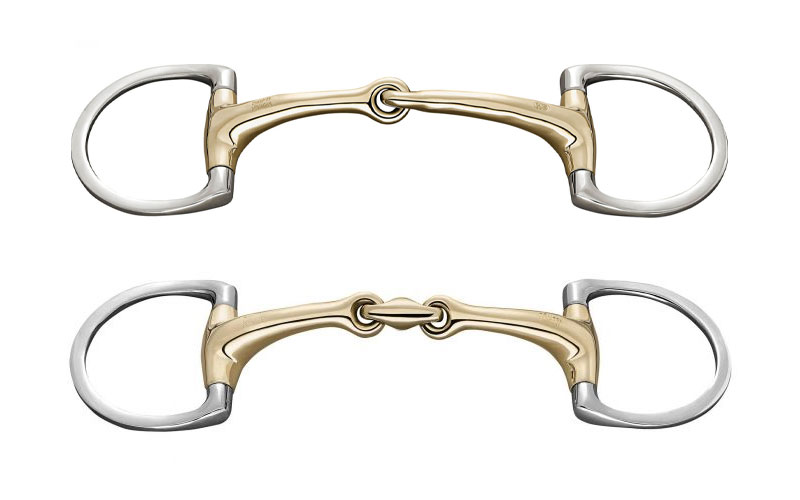
There really is no general answer to this question. It always depends on the combination of horse and riding. Some horses prefer a single bit and others a double bit. You should also take your own riding into account when making your decision. If you have a rather strong hand, the double jointed bit is probably not the right choice.
Simply broken bits:
- consists of the side rings (continuous or D-rings) and two legs that are movably connected in the centre
- it acts on the horse's poll and tongue
- with one-sided rein aids, it is only possible to give very differentiated aids
- it is possible to give very differentiated aids
- the horse can briefly counteract pressure by pressing the bit against the palate with the tongue
- The "nutcracker effect" (the bit stands up with too much rein pressure) has now been refuted by studies
Double jointed bits:
- double jointed bit consists of side pieces, two shanks and an olive-shaped piece in the centre
- it acts on the horse's tongue and bars
- Encloses the tongue and therefore lies more quietly in the mouth
- Pressure should be better distributed
- with strong rein pressure, it has a very strong effect on the bars
- if the pressure is too strong on both sides, the tongue is squeezed
- the horse CANNOT escape this pressure if it presses the bit against the palate
Which is better? Single or double broken?
Your horse will show you whether it likes the bit you have chosen or not. Signs of discomfort can be head banging, rolling in, going against the bit, locking, tongue misalignment (sticking out the tongue), discarding and generally all signs of a lack of suppleness. These signs can appear very quickly or gradually over a few weeks. If you are using a new bit, pay close attention to your horse's signs.
A well-known saying on this subject is: The rider's hands determine how the bit works, not the bit itself.

The classic
Water snaffle
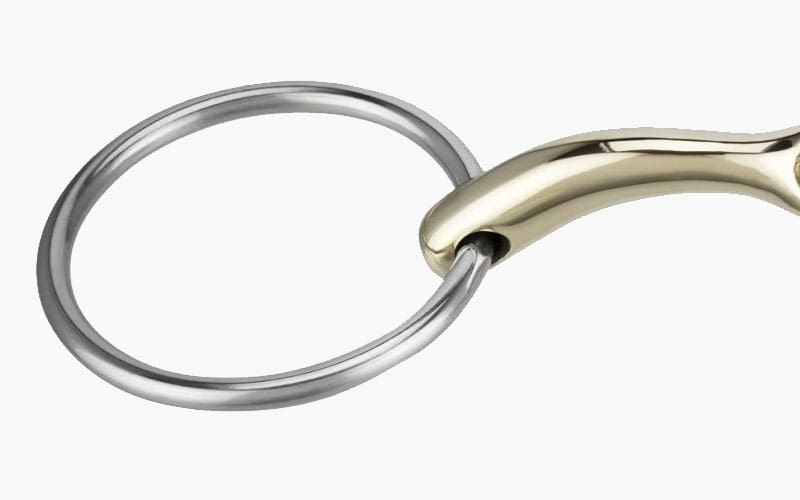
A water snaffle is a bit with continuous rings. Water snaffles work exclusively by pulling. As the ring is flexible, it can easily compensate for an unsteady or untrained hand. In addition, the horse can temporarily avoid too much pressure by lifting the tongue.
Water snaffles are available as single-jointed and double-jointed bits, but also as bar bits. Multijoint bits are also available with continuous rings, but are rather rare.
The water snaffle is the classic bit with which all horses generally run well and are also trained.
Direct effect
Olive head bit
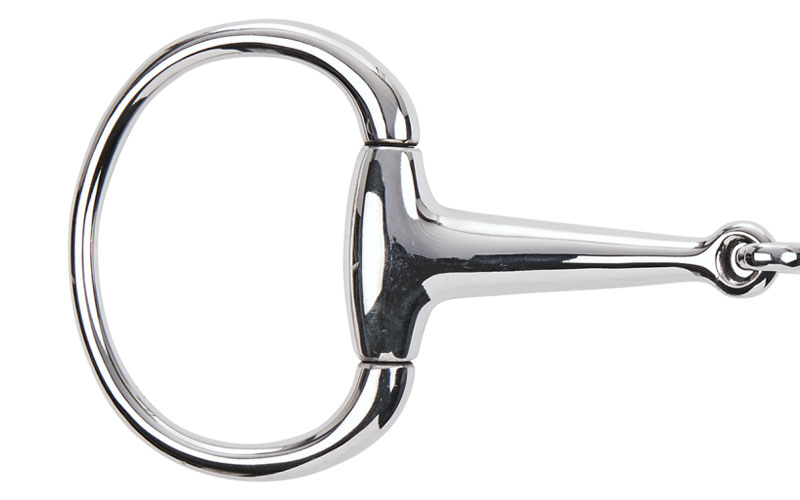
Olive head bits are comparable to water snaffles in their mode of action, but the rein aids are transmitted more directly. Due to the firm connection between the mouthpiece and the ring, the bit lies quietly in the horse's mouth. This bit also makes it easier to guide the horse laterally.
Olive head bits are not recommended for young horses if the horse is not yet familiar with a bit. Riders with a hard hand or beginners with unsteady hands should also choose a water snaffle bit, as the movement is transmitted directly to the tongue and not cushioned. Olive head bits should generally be 0.5 to 1 cm smaller than a ring snaffle so that the side parts fit loosely on the horse's mouth.
Olive head bits are also available as single and double broken versions, as well as bars.
For independent hands only
Bar bit
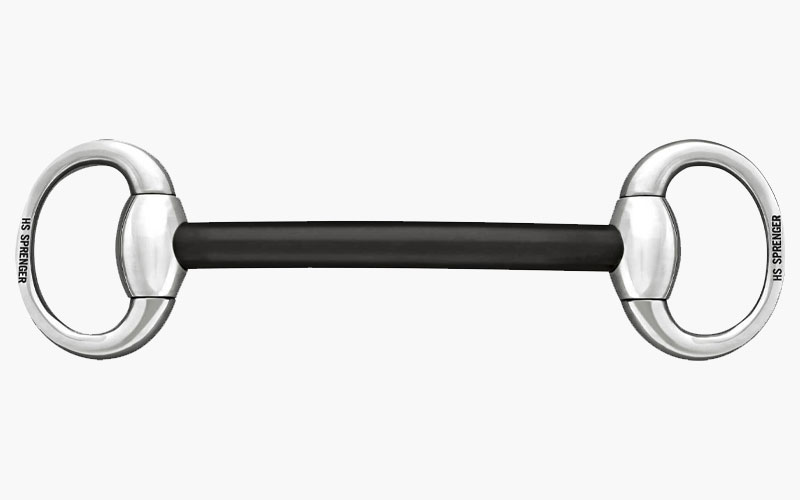
Bar bits are available in many different materials and shapes. They only belong in the hands of experienced riders, as one-sided rein aids or the development of position and bending is not possible with a bar bit.
Bar bits exert even pressure on the entire tongue. In contrast to single or double jointed bits, less pressure is exerted on the edges of the tongue. You should always choose a bit that fits your horse perfectly, because if the bit is too big, it can tilt if the rein pressure is applied on one side.
Bar bits are often used for very strong horses that, for example, evade the rider's aids when approaching an obstacle. A bar bit with tongue freedom can also be an advantage for horses with tongue problems (sensitivity to pressure - tongue is pulled up or stuck out to the side).
Flexible bar bits are particularly suitable for horses that occasionally get stuck and are often well accepted by horses that do not cope well with broken bits. A good alternative to the classic bar bit is the Max Control bit from Sprenger, which initially acts like a normal broken bit and turns into a bar when strong pressure is applied.
However, it is always important to handle the bar bit sensitively. The rider should be able to ride the horse independently of the reins using weight and leg aids.
Rarely seen in English riding
Baucher bit / Fillistrense / B-ring bit
- sits much more quietly in the horse's mouth due to its firm buckling with the bridle
- works towards the corner of the mouth, which leads to more uprightness in many horses
- also has a lateral effect due to the fixed side parts
- unlike simple snaffles, they do not sag downwards
- can only be pushed minimally towards the stallion and incisors
- is suitable for horses with a short mouth gap
Contrary to popular belief , this bit does NOT have a leverage effect. When the reins are tightened, the strap to which the bit is attached moves outwards in a similar way to a water snaffle. This is because the bit needs a counter-pole, i.e. a chin chain, to be able to exert pressure on the poll.
Also called gag snaffle
Shank snaffle
- has lateral bars that have a directional effect
- lies more quietly in the horse's mouth
- often used for training young horses, for lunging or by show jumpers
- the right size is crucial so that the corners of the mouth are not pinched
For experienced riders only
Snaffle bit
- achieves maximum control through effective and targeted action on the corner of the mouth and poll
- has a straightening effect
- can only be used with special cheek pieces
Also called racing bit
D-ring bit
- do not differ in their mode of action from olive head bits
- The difference lies in the slightly more angular shape of the side pieces
- Shekels are usually firmly attached to the side pieces
For experienced riders only
3-ring bit, multi-ring bit or Pessoa
- acts on the corner of the mouth and neck
- sharp bit that works very quickly
- if you strap the reins into the large, centre ring, the bit acts like a water snaffle
- if the reins are buckled into the lower small ring, it becomes a sharp bit, as the leverage effect and thus pressure on the poll is added here
- Pessoa bit is used with two pairs of reins, similar to a curb bit
Brand for plastic bits
Nathe dentures
- are made from thermoplastic
- are suitable for sensitive and muzzle-sensitive horses
- are anti-allergenic and therefore very well tolerated
- are food-safe and free from plasticisers and solvents
- only medium to short service life due to soft material
- Bits with bite marks should be replaced immediately
For fine hands
Double bridles & snaffles
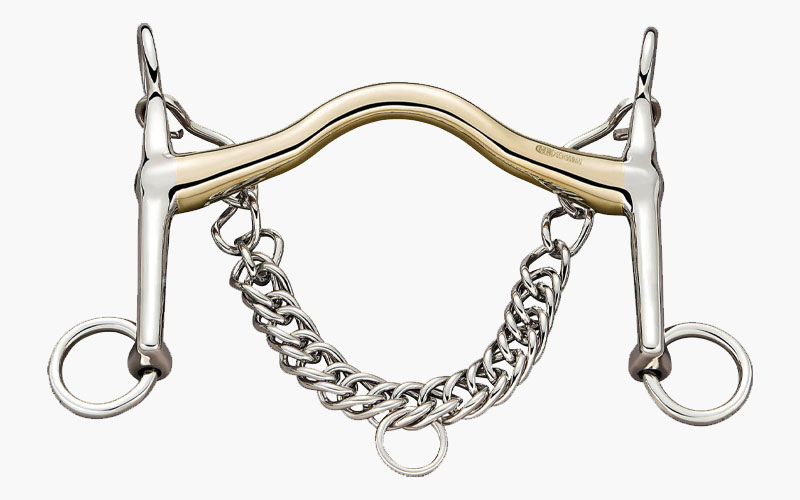
Curb bits are usually only used in advanced dressage and serve to refine the aids in advanced exercises. Both rider and horse should be trained accordingly. The rider should have a seat that is independent of the reins and a fine, gentle hand. This is referred to as "curb maturity".
Which bit material is suitable for horses?
Slightly sweetish
Sensogan bit
- material developed by Sprenger
- consists of a special composition of copper, manganese and zinc
- tastes slightly sweet, which should encourage the horse to chew
- material is toxicologically tested and classified as harmless
Favourable classic
Stainless steel bit
- do not rust, are very durable and absolutely tasteless
- Weight depends on whether it is solid or hollow
- heavy use can cause sharp edges to form over time, which can injure the mucous membrane in the mouth
Plastic, rubber or leather
Soft teeth
- the solution especially for sensitive or allergic horses
- soft bits require more care and show signs of wear more quickly
- are not suitable for horses that chew hard
- material must be checked for sharp edges before riding
Sweet teeth with slight susceptibility to wear
Copper dentures
- designed to stimulate salivation and mouth activity
- Made from a stainless steel core with copper alloy
- surface scratches easily due to the soft surface material and can form sharp edges
Blue dentures from Trust
Sweet Iron bit
- Colour changes to brown-grey through use of the bit
- surface forms a light rust layer through contact with moisture
- tastes sweet and stimulates your horse to salivate and chew more
The most frequently asked questions
Bits FAQ
Diese Frage bekommen wir häufig gestellt. Die Antwort hängt von den Umständen ab und lässt sich nicht pauschalisieren. In der Regel laufen alle Pferde mit einer Wassertrense gut – sei es einfach oder doppelt gebrochen.
Für Pferde, die etwas mehr seitliche Anlehnung benötigen oder zum Longieren, bietet sich eine Schenkeltrense oder Olivenkopftrense an.
Rollt sich dein Pferd ein, oder hebt es sich raus? Diese Frage solltest du dir zuerst beantworten, denn sie führt zu unterschiedlichen Antworten. Pferde, die nicht richtig ans Gebiss herantreten, haben meist gar kein Problem mit dem Gebiss an sich. Der Motor (Hinterhand) ist einfach aus. Versuche zuerst die Hinterhand deines Pferdes fleißiger zu bekommen, bevor du das Problem beim Gebiss suchst.
Sollte die Hinterhand deines Pferdes aktiv sein (schnell bedeutet aber nicht gleich fleißig) und du dennoch Probleme haben, gibt es u.a. folgende Gebisse:
Sprenger bietet das WH Ultra Gebiss an. Das rollende Element fördert die Maultätigkeit, Durchlässigkeit & Konzentration. Es entspannt den Kiefer und die Oberlinie, wodurch das Pferd schneller abkaut.
Das Sprenger Turnado Gebiss eignet sich für Pferde mit Zungenproblemen.
Ganz besonders ist das Sprenger Novocontact Gebiss. Die einfach gebrochene Variante ist für Pferde geeignet, die nicht an das Gebiss herantreten wollen. Wohingegen die doppelt gebrochene Version für Pferde konzipiert ist, die sich gelegentlich stark machen und gegen die Hand gehen.
Für junge Pferde eignen sich einfach oder doppelt gebrochene Wassertrensen. Denn damit laufen in der Regel erst einmal alle Pferd gut. Eine unruhige Hand wird durch die beweglichen Ringe ausgeglichen und das Pferd kann zu viel Druck kurzzeitig durch Anheben der Zunge entgehen.
Bei einem Gebiss mit beweglichen Seitenteilen (z.b. Wassertrense) sollte das Gebiss nicht ganz eng anliegen, da die Ringe frei beweglich bleiben müssen. Gebisse mit festen Seitenteilen (z.B. Olivenkopfgebisse) können eine halbe bis ganze Größe kleiner gewählt werden.
Als erste grobe Einschätzung kannst du den „2-Finger-Test“ nutzen. Dazu steckst du Zeige- und Mittelfinger an die Stelle ins Pferdemaul, an der auch das Gebiss eingelegt wird. Verspürst du Druck auf beiden Fingern, liegt die empfohlene Stärke bei 14 – 16 mm. Verspürst du hingegen kaum Druck, kannst du auch ein Gebiss mit einer Stärke von 16 – 18 mm verwenden.