
Function and benefits
Are fly rugs useful?
Fundamentals
What is a fly rug actually?
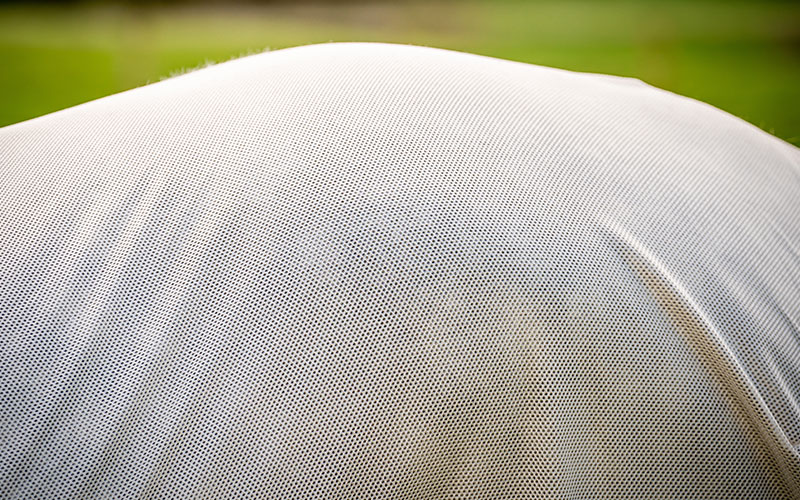
A fly rug for horses is characterised by a particularly close-meshed net structure. These tight meshes prevent pesky insects such as flies, horseflies or tingling midges from penetrating the horse's skin.
But why not just use a cotton blanket to keep insects out? It's quite simple! Your horse would sweat too much in summer. The tight mesh of a fly rug doesn't let any insects through, but it is breathable and allows air to pass through. This counteracts heat build-up.
Which horses are suitable for fly rugs?
Fly rugs are suitable for all types of horses. Whether warm-blooded, thoroughbred, cold-blooded or pony - all horses benefit from a fly rug if they are exposed to insects.
- For horses that feel very disturbed
- Horse runs up and down restlessly in the meadow
- Horse is unfocussed when riding, flaps its head, flaps its tail a lot
- clipped horses that have no natural protection as a result
- Horses that show defence reactions such as pustules or wheals
- Eczema sufferers (mane and tail rubbed by black flies)
As soon as your horse shows these reactions, you should consider using a fly rug.
Many horse owners cover their horses with a fly rug from the middle/end of May, when the insect load is particularly high and the grazing season begins.
What should I bear in mind when buying a fly rug?
There are a few questions you should ask yourself before buying in order to find the right fly rug:
- Type of fly rug: simple, with neck part or eczema rug
- Size: Base this on your horse's normal rug size. The rug must not be too big so that no crawling creatures can slip underneath. However, it should also not be too tight so that it does not constrict or chafe and your horse can move properly
- Tear resistance: If your horse tends to romp around a lot, you should make sure it has a high tear resistance
- Colour: choose a light-coloured rug that reflects the sunlight or a zebra rug
- Features: cross surcingles, leg straps and tail straps ensure a non-slip fit even during and after rolling around
Suitable for your horse
Fly rugs - types
The needs of a horse can be quite individual. That's why manufacturers offer different fly rugs. This allows you to choose the right rug for your horse with little to no compromise. We explain the different models below.
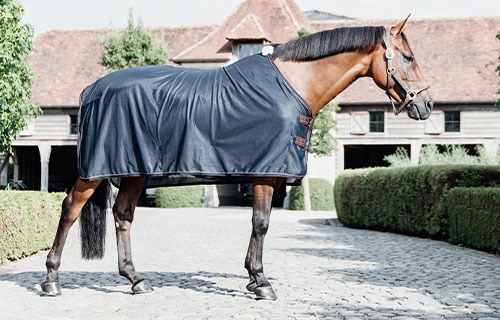
Standard model
- is cut like a classic horse rug
- with Velcro or a hook fastener at the front
- usually cross surcingles and tail strap
- suitable for uncomplicated, less sensitive horses
- also suitable for transport in summer
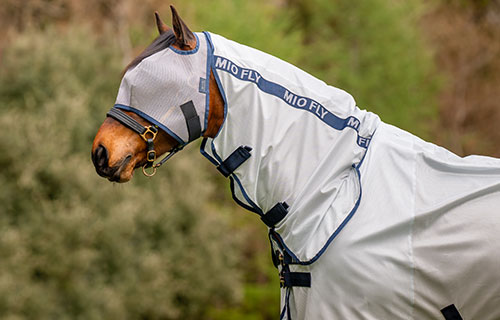
With neck section
- also protects the neck up to the ears
- either firmly sewn to the blanket, or attached to the blanket with Velcro / hooks
- usually with Velcro fastener for attachment to the halter
- otherwise the same as the standard model
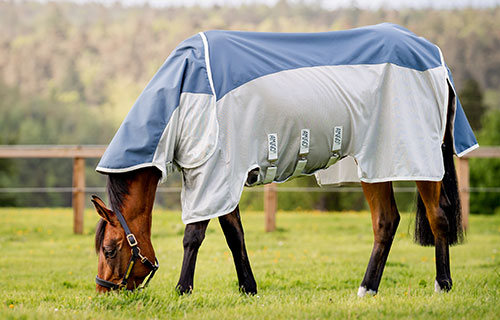
With rain cover
- Water-repellent fabric in the back area protects against rain showers
- material is usually very light to prevent sweating
- ideal for changeable weather
- at least with cross surcingles, front fastening and tail strap
Eczema rugs
- for very sensitive horses that are prone to skin problems and chafed manes and tails
- is made of a very close-meshed, breathable material
- always has a neck part, sometimes with sewn-in ears or ear cut-outs
- belly bib protects the majority of the horse's belly
- long tail flap protects the sensitive tail rump
- fits closer to the horse's body
- Elasticated inserts ensure greater freedom of movement
Fly riding rugs
- have a saddle cut-out
- are fastened in front of the saddle with Velcro
- also available with chest closure
- also available as a kidney fly sheet
Zebra blankets
- Insects cannot easily recognise the horse due to the stripes
- Stripe pattern prevents horseflies from targeting the horse
- protect somewhat more effectively against insects
Questions simply answered
Fly rugs - FAQ
Das hängt ganz vom Material der Decke und der Intensität des Regens ab. Die Decke sollte sehr schnell wieder trocknen, damit es nicht zu Scheuerstellen und Verkühlungen kommt.
Ist es eher kalt, solltest du die nasse Fliegendecke lieber abnehmen, da sie nicht schnell genug trocknen wird. Die Nässe darf sich außerdem nicht unter der Decke stauen. Wenn sich Regen ankündigt, solltest du eher zu einer Fliegendecke mit Regenschutz im Rücken greifen.
Prinzipiell steht dem nichts im Weg. Du solltest aber auf die Qualität und den Komfort der Fliegendecke achten. Bei einigen Pferden, vor allem beim Sommerekzem und stark allergischen Pferden bleibt dem Besitzer leider nichts anderes übrig, als die Decke 24 Stunden drauf zu lassen.
Achte darauf, dass dein Pferd genug Bewegungsfreiheit hat und es nirgendwo zu Scheuer- und Druckstellen kommt, wenn die Decke über einen längeren Zeitraum auf dem Pferd bleibt. Zudem solltest du auf eine hohe Atmungsaktivität achten, damit dein Pferd nicht unnötig schwitzt und die Haut ausreichend Luft abbekommt.
Pferdedecken zum Schutz gegen Fliegen und anderen Insekten sind schon relativ günstig zu kaufen. Einfache Modell von Busse, Kalvalkade oder Waldhausen sind schon für um die 30 € erhältlich.
Willst du mehr Funktionen, eine bessere Reißfestigkeit oder zusätzliche Optionen wie ein abnehmbares Halsteil, wird die Fliegendecke teurer. Unsere beliebtesten Hersteller für Fliegendecken sind Horseware, Eskadron, Bucas und auch Kentucky Horsewear.
Wenn dein Pferd unter der Fliegendecke schwitzt, solltest du auf ein leichteres Modell ausweichen. Vor allem solltest du ihm auf der Weide auch einen schattigen Platz ermöglichen, beispielsweise mit einem Unterstand. Helle Fliegendecken reflektieren das Sonnenlicht, wodurch es unter der Decke nicht so warm wird. Bucas bietet auch spezielle Fliegendecken mit extra UV-Schutz an, welche für mehr Sonnenschutz sorgen.