
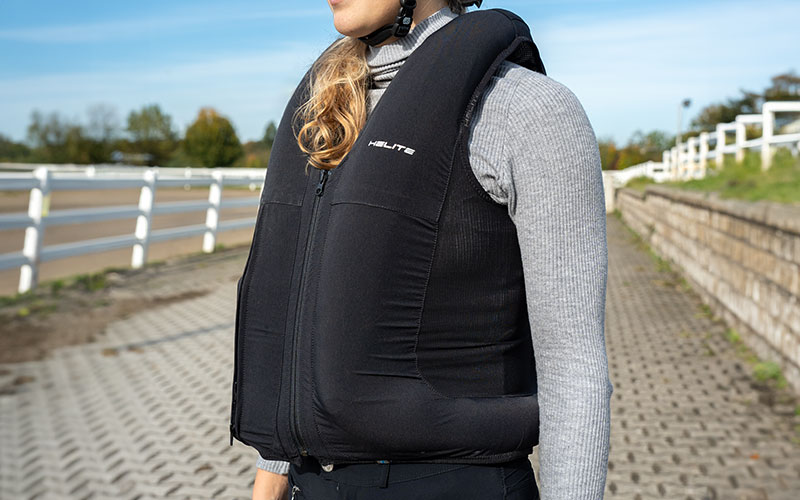
Protect your body
You should wear a safety waistcoat to protect yourself in the event of a fall, especially in show jumping or cross-country and when working with young or insecure horses.
Airbag waistcoats can be worn comfortably like a riding waistcoat and inflate at lightning speed in an emergency to protect your chest, back and neck.


How to find the right size of safety waistcoat
The safety vest or back protector must not be too large or small and should fit snugly around the body. However, it must not restrict movement. Measure the size while you are sitting in the saddle, as the safety waistcoat must not hit the saddle. Leave about 5cm between the back pommel and the lower edge of the waistcoat.
There are also back protectors and safety waistcoats with Velcro fasteners on the side so that they can be ideally adjusted and can also grow a little.
Which protection class is the right one?
- Level 1: Lowest protection, usually special waistcoats for professional jockeys, for example.
- Level 2: Medium protection for equestrian sports with moderate risk. Most back protectors have this level of protection and offer a good compromise between comfort and protection. Level 2 riding waistcoats generally protect the spine and coccyx.
- Level 3: Highest protection, for children, beginners, show jumping or eventing and cross-country riders. These protectors protect the entire upper body from impact damage and blows from hoof kicks, for example.
- Airbag waistcoats: In addition to the spine and chest, the neck, rump and pelvis are also better protected than with conventional protectors. They are also very thin and offer a great deal of freedom of movement until they inflate in a matter of seconds.
How do airbag waistcoats work?
After mounting, the airbag waistcoat is connected to the saddle by a ripcord. If the rider falls, the ripcord tightens and triggers the cartridge mechanism. The contained gas now flows into the chambers of the airbag waistcoat in a fraction of a second. This protects the rider from the powerful force of the impact. A few minutes after inflation, the airbag waistcoat slowly releases the air again and the deflated cartridge can be replaced with a new one. If in doubt, you should always have a spare cartridge with you or at least close by so that you can get the waistcoat ready for use again straight away.
Does the deployment scare my horse?
The deployment of the airbag waistcoat is not silent. You can compare the volume to a loud hand clap. So it's not quite as loud as you might think. The dropping of poles when jumping can be much louder. If you are unsure, use a cartridge and have the waistcoat triggered in a safe environment. This will give you a better idea of your horse's reaction.