
Types, application, advantages & disadvantages
Auxiliary reins for horses explained
Auxiliary reins (or stirrups) are intended to support the novice rider. Of course, the rider is not immediately correctly balanced, cannot ride the horse with the correct contact and in most cases there is also a problem with the seat. Correct hand position, correct seat, correct aids and then also looking where you are going. All of this can overwhelm a new rider at first. Auxiliary reins should help to feel and learn the correct seat. Because if the horse is limited at the front by the auxiliary reins, the rider can initially only concentrate on the seat. In the best case scenario, the horse should arch its back and let its neck fall.
Regardless of whether it's a triangular rein, a head rein, a running reins or a chambon - the auxiliary reins should only be attached after the horse has warmed up! Furthermore, auxiliary reins should always be removed in the field. The martingale is an exception here, but it has a special place among the auxiliary reins.
Correctly used auxiliary reins are not inherently bad. After all, they do what they are designed to do - help! And that is to help the novice rider and the horse.

Tie-out reins (tie-outs)
Every novice rider is familiar with the stirrup. The reins always consist of two individual "reins" that are attached to the left and right between the bit ring and the saddle girth. It is important to ensure that the reins are fastened high or low enough on the girth so that they lie horizontally when the horse is walking with the correct head position. They must be set long enough so that the horse does NOT get behind the vertical when correctly leant on.
Advantages of binders
- give the horse a clear frame
- Bending sideways and forwards
- Rider can concentrate fully on the seat and let go of the reins from time to time
Disadvantages of binders
- no forward-downward stretch possible = horse comes behind the vertical and rolls up
- elastic components (if present) lead to lying down, horse comes onto the forehand
Conclusion
Riding reins are suitable for beginners on the lunge or for their first riding lessons in a group. Where the rider's steady hand and the right influence are still lacking, the reins can provide support.

Triangular reins (Vienna reins)
Triangular reins are a very popular form of auxiliary reins, along with the binders. They are also often used for lunging.
The triangular reins consist of a thick strap that runs between the forelegs and is attached to the centre of the girth. In front of the chest, the thick strap forks into two individual, slightly thinner straps. These are passed through the respective bit ring on the left and right from the inside to the outside and attached to the saddle girth (or lunging girth).
When the head is correctly positioned, the strap should be slightly horizontal just before the vertical.
Advantages of triangular reins
- The head is prevented from being pulled up
- stretching posture is permitted
- for riders who can already limit the horse laterally
- for riders who are not yet able to approach the hand
Disadvantages of triangular reins
- Hardly any lateral limitation
- Horse gets behind the reins if it drops the halter too low
- Forward-downward is only possible up to a certain point
Conclusion
Triangular reins are a good aid for beginners who have already mastered lateral aids but still need support to the front. These auxiliary reins can also be used well when lunging, as they allow the horse to stretch to a certain depth.

Running reins (Phillips reins)
At first glance, the Lauffer reins are reminiscent of triangular reins. However, unlike this, the Lauffer reins consist of two individual leather or nylon straps. It is probably the most versatile auxiliary rein you can use.
Advantages of Lauffer reins
- can be used for stretching as well as for straightening up
- The design with snap hooks allows the harness to be quickly strapped on
Disadvantages of Lauffer reins
- Horse can get behind the vertical and curl up
- hardly any lateral restraint when buckling like triangular reins
- Careful attention must be paid to the length of the auxiliary reins so that the horse does not curl up and become tight in the poll
The various harnessing options
The Phillips reins are buckled like a triangular rein for the solution work and for stretching. Both straps are attached to the bottom of the girth and passed between the front legs. Now pass them through the respective bit ring from the inside to the outside and attach them to the saddle girth on the right and left.
In order to achieve a higher level of uprightness or more lateral restraint, one end is buckled further up. Now pass the running reins from top to bottom (i.e. from the outside to the inside) through the respective bit ring and attach them to the saddle girth or a ring on the lunging girth again at the level of the front joint.
The effect is enhanced the further up the auxiliary reins are attached. However, the horse must always be able to keep its forehead-nose line in front of the vertical.
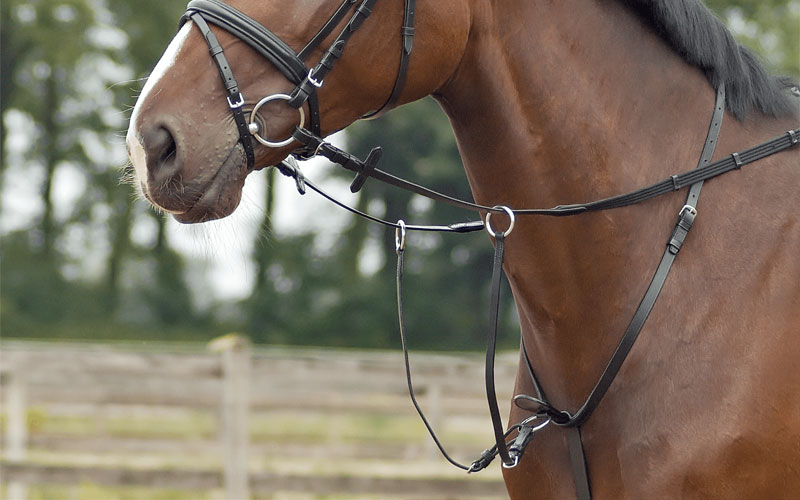
Martingale
Like the breastplate, the martingale is more commonly seen on show jumping and cross-country riders. In show jumping, it is used to "secure" the reins should the rider lose them in a fall. This prevents the horse from stepping on the dropped reins and possibly injuring itself.
The sliding ring martingale is designed to prevent the horse from pulling its head up. The martingale is buckled in such a way that the martingale fork is slightly slack when the reins are correctly positioned. If the horse now raises its head, the reins are bent by the rings and pressure continues to be applied to the horse's poll. This pressure does not point backwards, but downwards.
Conclusion
The martingale is not only a safeguard in the event of a fall, but also a helpful aid for advanced beginners. If they have already mastered the lateral aids but still have an unsteady hand or are not yet able to ride the horse up to the hand, the martingale has a supportive effect. As it is only effective if the horse raises its head too high, but can still stretch forwards and downwards on the reins, the martingale is, in our opinion, one of the most useful auxiliary reins.

Thiedemann reins (charcoal burner's reins)
The Thiedemann or charcoal burner reins can be seen as a slightly less complex version of the loop reins. It consists of reins with rings and the actual auxiliary reins. The ring is placed loosely around the horse's neck and the wide strap is passed through the front legs to the saddle girth. The two narrow straps are passed through the respective bit ring on the left and right from the inside to the outside and attached to the rings on the reins. The Thiedemann reins must be buckled in such a way that they are only used if the horse's head is too far forwards or upwards.
Advantages of Thiedemann reins
- only one pair of reins must be held
- only works when correctly buckled if the horse's head is too far forwards or upwards
- should sag slightly when the horse is walking in the correct position
Disadvantages of Thiedemann reins
- leads to a blunt horse's mouth if used incorrectly
- does not provide any lateral restraint
- "sharp" auxiliary reins that only belong in professional hands
Conclusion
The Thiedemann reins must NOT be used by beginners. It belongs exclusively in fine rider's hands and is used solely for short corrections. It should therefore be categorised as a correction aid rather than an auxiliary rein. Incorrect use of this rein can harm the horse!

Chambon & Gouge
Chambon and Gogue are used to teach the horse to lower its head when pressure is applied to the mouth and poll. Chambon and gogue are suitable for horses that find it difficult to stretch and have difficulty dropping their neck. If the horse raises its head too high, the chambon and gogue put pressure on the poll and corner of the mouth. If the horse lowers its head, the pressure eases. If the posture is correct, there is no help at all. Unlike the chambon, the gogue can also be used under the rider.
The chambon should only be used when lunging, as the rider must continually give way very quickly as soon as the horse shows the slightest tendency to move forwards and downwards. Hardly any rider has this ability to react.
Chambon and Gogue only belong in the hands of very experienced riders. If the reins are not buckled correctly, the horse may react violently in defence. Only use these auxiliary reins if you are under supervision and only in individual cases.
Disadvantages of Chambon
- offers neither the possibility to lean in nor a lateral limitation
- Many horses curl up to avoid the pressure on the corner of the mouth and neck
- The length of the auxiliary reins is crucial
Disadvantages of Gouge
- independent gouge: in addition to the disadvantages mentioned for the chambon, it also has a backward-facing effect
- led gogue has the same disadvantages as a loop rein
Conclusion
Chambon and Gogue are not real auxiliary reins, but rather correction aids that should be used very carefully. They are neither suitable for beginners nor for "trying out while lunging to see if it works". There should always be a riding instructor or rider present who is very familiar with this type of auxiliary reins.
As mentioned above, incorrect use can lead to a strong defence reaction and, in the worst case, cause serious injury to the horse. These two auxiliary reins should therefore be used with caution and it should be considered before use whether health problems (tension in the poll, girth or withers) are responsible.

Incorrectly named, because nothing is extended here!
Neck extender
The name neck lengthener suggests that it encourages the horse to stretch its neck. However, the more the horse stretches, the greater the pressure on the bit and the poll. With a normal head position, the neck extender is ineffective because it must then sag.
Conclusion
It is often buckled too tightly. If the horse now stretches down, the elastic strap tightens and the pressure increases. The horse then either crawls behind the reins to escape the pressure - or lies down on the reins and becomes lame. The neck extender can still be said to have an upward limiting effect, but the name is extremely inappropriate for these auxiliary reins.

Loop reins
Loop reins - the torture tool of the roll cure. At least that's how most riders remember these auxiliary reins. Unfortunately, the draw reins are often used secretly or not so secretly to force the horse to sit up and close.
In Switzerland it is forbidden in competitions and on warm-up arenas in show jumping, in Austria also in dressage. Because far too often you see it being used incorrectly.
The loop rein is used to restrain a horse that is pushing upwards. A rider must have such a fine feel and hand that he also gives way immediately at the slightest yielding of the horse. The pressure on the horse's mouth is doubled by a loop rein! In principle, the rider must not force the horse into a position and fix it there. The horse cannot escape the draw reins!