
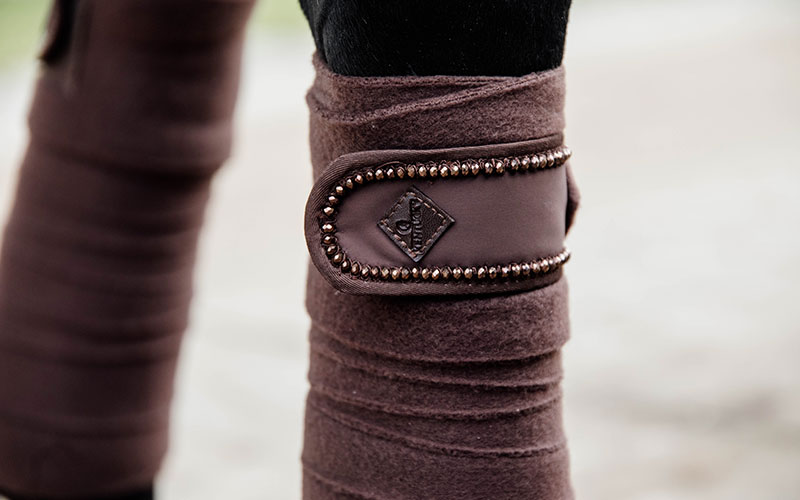
Fleece, elasticated, cotton
Bandages for horses
Bandages are wrapped around the horse's legs to provide protection and stability. They are used on the front and hind legs. They help to support the tendons and protect them from injury.


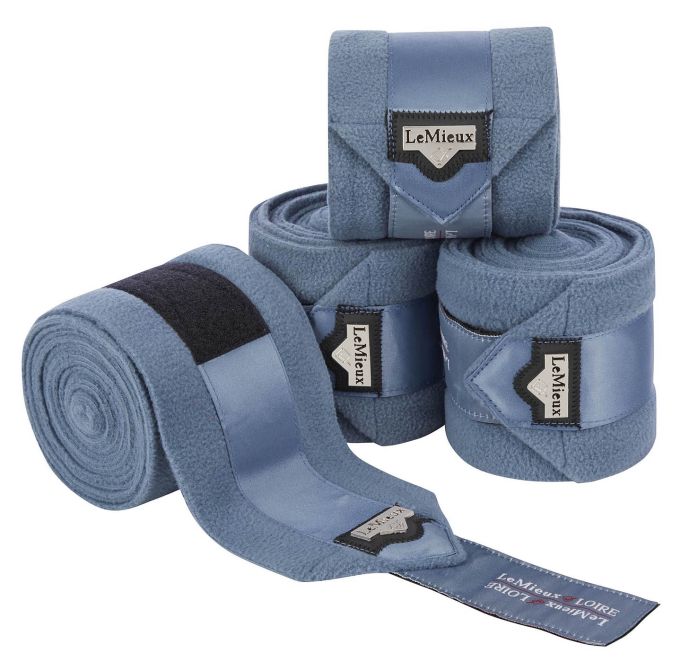
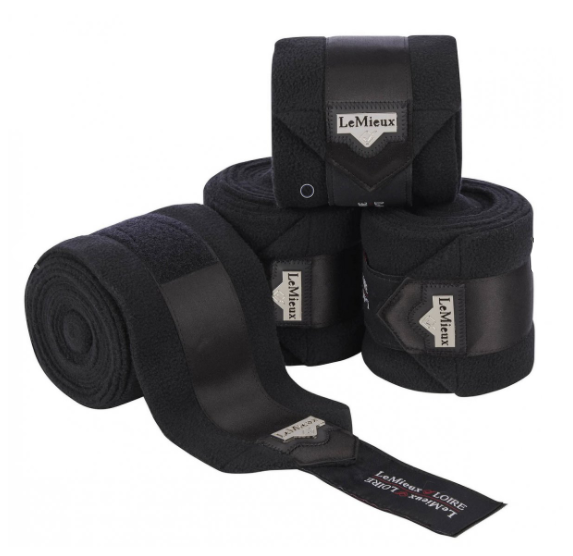
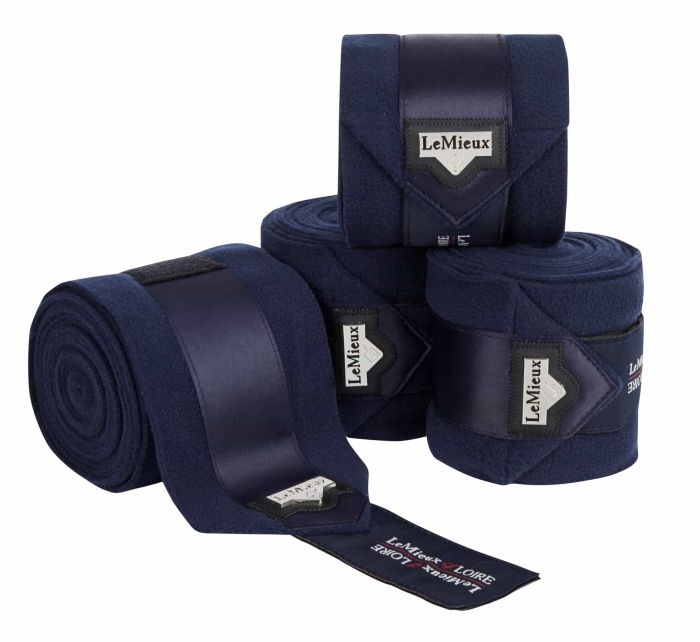


How to bandage your horse correctly:
Use underlays: Bandaging underlays help to distribute the pressure evenly and prevent excessively tight wrapping. There are also bandage pads with Velcro fasteners that are easy to put on.
Pay attention to the tension: The wraps should not be too tight so as not to impair the connective tissue, blood circulation and lymph flow.
Use fleece material: Fleece bandages are easier to handle and can often be used without underlays. They are also easy to care for, keep their shape and are available in many colours.
Preparation and instructions: Bandaging the horse
Before you start, you need to wind up the elastic & fleece bandages correctly. Unwind them completely once and then rewind them with the Velcro fastener facing inwards. When everything is ready, follow these steps:
- Apply the underlay: Place the bandage pad around the cannon bone in the centre from the outside to the inside, without folds. Tip: Underlays with Velcro fasteners make it easier to apply.
- Start wrapping: Start wrapping from the front outside to the back inside downwards, with even intervals of about 3-5 cm.
- Half of the fetlock head: Once you have reached the level of the fetlock head, wrap upwards again. The spacing can be slightly larger here (approx. 6-8 cm).
- Close the Velcro fastener: Close it so that the Velcro fastener is on the outside and facing backwards.
- Adjust the length: With a little practice, you can wrap the bandage so that it fits exactly once from top to bottom and back again.
Matching bandages for a coordinated outfit
The right outfit for you and your horse completes the overall picture. Matching bandages in combination with saddle pads and other accessories ensure a perfectly coordinated look.
At Lepona.de, you can find bandages in a wide range of colours - from subtle shades to eye-catching trend colours. This allows you to customise your horse outfit to suit your personal style and harmoniously coordinate all elements.
Whether classic and elegant or sporty and modern, with a coordinated outfit you will always make a stylish impression, both in training and at competitions.
They are particularly suitable for supporting and protecting the legs during training or in the stable. They help stabilize the tendons and prevent swelling or minor injuries.
Während Bandagen individuell um das Bein gewickelt werden und aus elastischen oder weichen Materialien bestehen, sind Gamaschen festere Schutzhüllen, die leichter anzulegen sind. Fleecebandagen bieten eine individuellere Anpassung, wohingegen Gamaschen schneller einsatzbereit sind.
Bandagierunterlagen bieten zusätzlichen Schutz für das Pferdebein, indem sie den Druck der Bandagen gleichmäßig verteilen. Sie reduzieren das Risiko von Druckstellen und sind besonders bei längeren Ritten oder Transporten hilfreich.
Für den Transport eignen sich besser spezielle Transportgamaschen, die das Pferdebein vor Stößen und Verletzungen schützen.
Bandagen lassen sich meist bei 30 Grad in der Maschine waschen. Um sie zu schonen, empfiehlt es sich, sie in einem Wäschenetz zu waschen und an der Luft trocknen zu lassen.
Bandagen sind in verschiedenen Materialien erhältlich: Fleece bietet Weichheit und Atmungsaktivität, während elastische Bandagen mehr Halt bieten. Baumwolle ist ebenfalls eine gute Option, da sie hautfreundlich und robust ist.
Ja, Bandagen können im Stall genutzt werden, vor allem in Kombination mit Unterlagen, um die Beine zu stützen oder Schwellungen zu vermeiden. Achte darauf, sie regelmäßig zu überprüfen und bei Bedarf neu zu wickeln.